Saturday, May 22, 2010

Choosing vintage fabrics (part1)


It is sometimes difficult when choosing fabrics online to get a clear idea of the subtleties of weave, weight and tone. This can be especially tricky when considering which fabrics complement each other and/or colour schemes.

Most of our antique and vintage linen has either a stone/oatmeal or cream/wheat coloured base. We try our best to accurately describe tones. When choosing fabrics to be used together the background tone is probably the most important consideration and going for either the grey/stone/ porridge tones or the wheat/cream/yellow tones is a good starting point

Mixing striped linen with plain often works well and for larger projects using any combination of grain sacks, cart covers, mattress covers, sacks and sheets with the same tones can produce stunning results.

Over the next few weeks we will be presenting examples of combinations of vintage linen which could be used for interior projects. We will also be suggesting complementary Farrow and Ball paint colours as we aware that like us many of our customers use Farrow and Ball.

(Farrow and Ball is an English company producing environmentally friendly paints with a fantastic range of neutral (and other) colours. They go particularly well with our vintage fabrics.

Thursday, May 13, 2010

Period Living

Featured in Junes issue of Period living (UK). This shows one of our cushions from grain sack fabric ( not a chunky hemp cushion as it says in the caption!)

Monday, May 10, 2010

Bespoke cross stitch embroidery

Our bespoke, hand embroidered cross stitch pictures are featured in this weeks Country and Town House magazine ( bottom right in the image above)

Friday, May 7, 2010

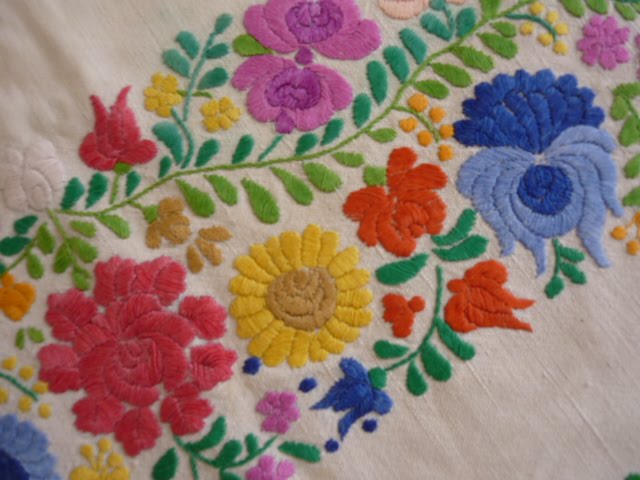
Kalocsa Embroidery


Kalocsa , 88 miles South of Budapest is a small town famous for its paprika and its folk art.

Colourful motifs including flowers and paprika were traditionally painted on walls, furniture, eggs and embroidered to make clothes and home furnishings

This style of embroidery using bright colours was popular at the beginning of the 20th century. Before that the embroidery of this area was generally done with white thread on white cloth.

The examples above are all vintage and embroidered on home woven cloth.

Friday, April 23, 2010

Vegetable dyed yarns by Renaissance dyeing

I first came across Andie of Renaissance dyeing sometime ago when I was seeking advice on dyeing vintage linen with vegetable dyes.

Andie is passionate about using plants to create the most wonderful coloured yarns

Andie and her Dutch husband Adrian have settled in the foothills of the Pyrenees, enabling Andie to indulge her life long passion for natural vegetable dyeing and colour.

Her atelier in is packed full of plants, wool and lots and lots of wonderful colour. Blues from woad and indigo, reds from madder, cochineal and brazilwood, yellows from weld, fustic and onion skins. Add oak bark, oak galls and logwood and you have a palette that produces over 150 different naturally dyed shades.

The dye-house and winding machinery are housed in a converted barn in an ancient hilltop village. In this traditional textile area amid wild dye plants and newly cultivated woad fields.


Tuesday, April 20, 2010

Stenciled vintage grain sacks


Stenciled vintage sacks. Home woven. Twill weaves. These come from villages in Southern Hungary. Some have the name, town and house number stenciled on them. Others just the owners name. As you can see some of the names are German. During the rule of the Habsburg empire Germans were encouraged to settle in Hungary and to work the land. 800 villages were founded in Hungary between 1711 and 1750 ( some of these are now outside the border of Hungary)

Thursday, April 1, 2010

Using vintage linen and grain sacks for upholstery projects

I am frequently asked about using these lovely vintage fabrics for upholstery. Their strong close close weave and distinctive look makes them fantastic for making original pieces of furniture

These fabrics were loomed on narrow home looms, widths vary but are rarely greater than 60cm a panel. Cart covers, sheets, mattress covers have all been made by sewing panels together, they are often beautifully hand sewn with hemp thread.

Cart covers are ideal for larger pieces and easier than fabrics from roll because the lengths are already hand sewn together.

These two pieces by Dan Marty design, the sofa is covered using what looks like a cart cover


The patchwork effect is also popular and often uses a mixture of grain sacks, of different colours with varying stripes and the odd monogram thrown in. This one is from Antiquted


and this one here from Hossack and Gray, this sofa is upholstered in a ix of striped and hand dyed vintage fabrics


and here is one, also from Hossack and Gray upholstered with indigo dyed vintage linen